Contents
It is precisely here that Alex Paciorkiewicz, the founder of the billion-złoty Foodcom S.A., saw an opportunity to build a new category of online trade. Today he is developing FDCM.eu – a platform designed to simplify global mid-volume trade and fill a gap that the biggest players had failed to notice for years.
From commodity trading to a new category
Foodcom S.A., the company founded by Alex Paciorkiewicz, became the largest private trading company in the raw materials segment in Poland in just a few years. It now operates in more than 40 countries, and its revenue exceeds PLN 4 billion. The company’s business model was based on handling large B2B contracts – deals worth millions of euros that require personal negotiations and long-term relationships with counterparties.
From the perspective of managing global volumes, however, it is clear that there is a significant gap between classic retail and large-scale wholesale. It is a segment where the value of a single order is not high enough to tie up traders’ resources, yet too large to fit the standard B2C model. In logistics it is called “groupage”, while in e-commerce people increasingly speak of mid-volume trade.
This area, long marginalised and considered unprofitable, has been generating more and more demand in recent years. The growing number of small and medium-sized enterprises, the development of local online shops and new sales models have turned mid-volume trade into a market with billion-złoty potential.
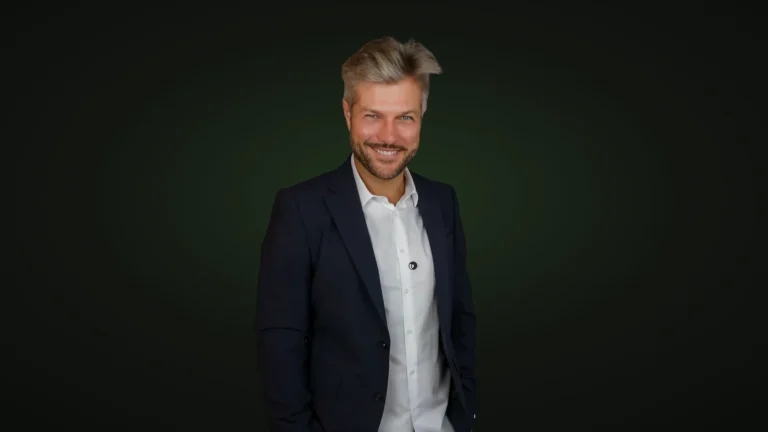
Alex PaciorkiewiczFounder & CEO, Foodcom S.A. & FDCM
A niche nobody reached for
The Polish e-commerce market has been growing at double-digit rates for years, and according to a Strategy& (PwC) report its value will exceed PLN 187 billion in 2027. The strongest growth is seen not only in B2C but also in the B2B segment, which is gaining an ever larger share of the market.
Despite this scale, the digitalisation of B2B purchasing processes remains fragmented. The biggest players focus on handling huge contracts, and e-commerce tools have been developed mainly with individual consumers in mind. As a result, orders ranging from a single pallet to a few tonnes were still waiting for dedicated solutions.
Mid-volume trade is not just a niche. It is a segment that could account for a significant share of the growth of the entire online B2B market in the coming years. The scalability of this model and the possibility of taking it to international markets mean that the gap is not only operational but also strategic and investment-related.
FDCM – an answer to the needs of smaller companies
Alex Paciorkiewicz’s new project was designed as a transaction platform dedicated to small and medium-sized buyers. Unlike classic wholesalers, which have to maintain stock and extensive logistics, FDCM works as a marketplace. This means that the offer is created in cooperation with producers and distributors, and the platform itself acts as a digital intermediary.
This approach lowers entry costs and makes it possible to expand the product catalogue quickly. At the same time, it lays the foundations for international expansion, because the same model can be scaled to other markets where the mid-volume problem remains unsolved.
We built a company that operates in 40 countries and handles the largest contracts, but the market was clearly asking for something new. FDCM was created so that smaller businesses could buy simply and on terms that used to be out of their reach.
How big can mid-volume trade grow?
FDCM is emerging as Europe’s first transaction platform focused on mid-volume trade. Its marketplace model makes it possible to expand the offer quickly and reach a wide group of smaller buyers. It is a solution that meets the needs of thousands of companies in Poland and has the potential to expand into foreign markets where the mid-volume problem remains unsolved.
The project’s advantage is that it draws on Foodcom’s resources – both its experience in global trade and the data collected over the years. As a result, it starts with a strong operational base, which increases its chances of scaling quickly.
This is not about adjusting an existing model, but about creating a new category. FDCM is meant to be a place where you can trade any goods, as long as they fit the mid-volume scale. It is a space that previously had no channel of its own, and today it can become one of the drivers of growth in B2B e-commerce.
New ground for investors
The development of FDCM shows that a completely new category is emerging in B2B e-commerce, and its importance may grow faster than that of classic retail. Mid-volume trade, ignored for years by the biggest players, is now becoming an area with global potential – and Poland could be one of the first markets to develop it professionally. From the capital market’s point of view, it is a project worth watching.
In building FDCM, we look beyond the local market. It is a project designed with expansion in mind, because the need to serve mid-volume buyers exists everywhere. And if it can be met, this is exactly where new value in B2B e-commerce will be created.